
A Complete Guide to Irrigation Repairs
The Hidden World Beneath Your Lawn:
Most homeowners don’t think about their irrigation system until something goes wrong.
A dry patch shows up. Water starts pooling where it shouldn’t. Or worse, your system just… stops working.
But here’s the truth:
Your irrigation system is one of the most complex and hard-working on your property. When it’s dialed in and functioning correctly, everything else improves. Healthier grass. Stronger plants. Less waste. Better results.
When it’s not? You’re fighting an uphill battle.
At Natural State Horticare, we approach irrigation repairs the same way we approach lawn care: methodical, precise, and built around long-term performance.
Let’s break down what that actually looks like.
1. Diagnostics: Finding the Real Problem (Not Just the Symptom)
Before anything gets fixed, we need to know exactly what’s wrong.
Leak Detection & Repair
Sometimes a leak is obvious. Water bubbling up, soggy areas, or a zone that won’t hold pressure.
Other times, it’s subtle. A slight pressure drop. A section of lawn that never quite looks right.
Some leaks are quick fixes, while others require more in-depth investigation. In rare cases, highly complex leaks may require specialized detection equipment
And if the issue is on a mainline (constant-pressure pipe), we take extra care. Repairs must cure for 24 hours before testing to ensure they hold under pressure.
Electrical Diagnostics
Not all problems are underground. Some are in the system’s “brain.”
We systematically eliminate failure points:
Valves
Wiring
Controller issues
Module failures
Using wire tracing tools and voltage meters, we don’t guess. We pinpoint the exact cause.
2. Major Repairs: Rebuilding the System the Right Way
These are the bigger fixes. The ones that restore full functionality and performance.
Known Leak Repairs
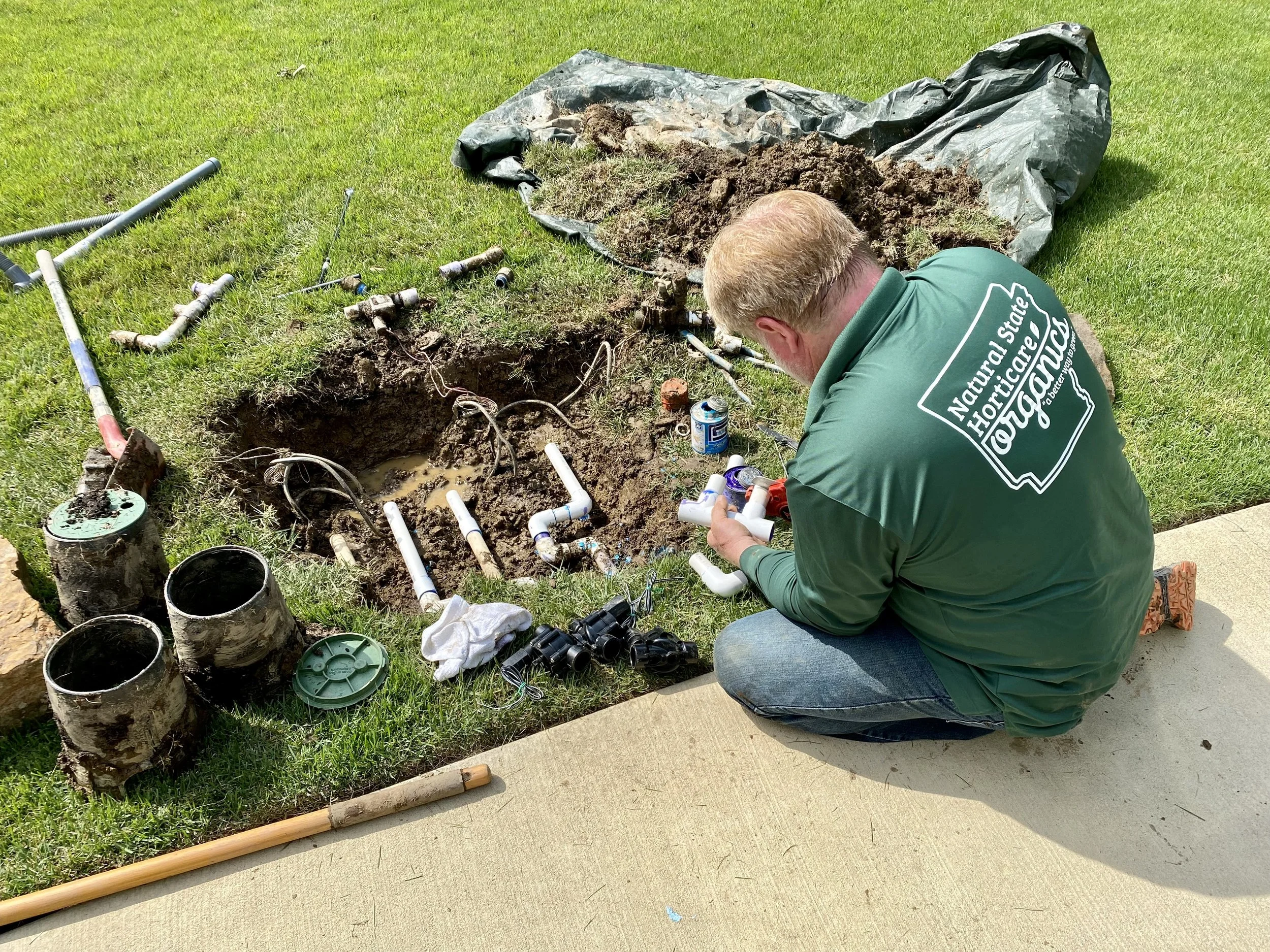
Once a leak is confirmed, we:
Excavate the area
Cut and remove the damaged pipe
Splice and glue new sections
Test and restore the area
Again, mainline repairs require proper cure time before testing. No shortcuts.
Adding a Sprinkler Head
If your system has dry spots, it’s not always about “more water.” It’s about better coverage.
We:
Trench to the new location
Tie into existing PVC
Run a new pipe
Install a properly positioned head
Pricing depends mostly on trenching distance, because that’s where the labor lives.
RPZ Leak Repair
Backflow preventers (RPZs) take a beating.
Common causes of failure:
Freeze damage
Physical impact
Worn seals
Seasonal wear from removal/reinstall
We identify the exact failure point and repair or rebuild accordingly.
Relocating Heads
One of the most common design flaws we see: poor spacing.
Sprinkler heads should overlap coverage. When they don’t, you get:
Hot spots
Dry areas
Inconsistent growth
We relocate heads properly and install new ones rather than reusing worn components.
Dividing Zones
Sometimes the system itself is overloaded.
Too many heads on one zone = low pressure = poor performance.
Or an often-overlooked issue: grass and landscaping sharing the same zone.
Why do we divide zones?
Increase pressure
Improve coverage
Separate watering needs (turf vs ornamentals)
3. Moderate Repairs: Fixing Performance Issues Before They Become Bigger Problems
These are the “middle ground” repairs that make a huge difference in how your system performs.
Head Replacement
Sprinkler heads don’t last forever.
They fail when:
They crack or break
Stop rotating properly
Don’t pop up high enough
We replace them with properly sized, properly installed heads for your landscape.
Taller Pop-Ups
Grass grows. Landscapes mature.
If your sprinkler head can’t clear the surrounding area, coverage suffers.
We install taller heads and adjust depth accordingly to restore proper spray patterns.
Valve Replacement
Valves control the nervous system. When they fail, signals from the controller (the brain) don’t get relayed, and things stop working.
When they fail, you’ll see:
Zones stuck on
Zones that won’t run
We dig, replace, and restore the system so it responds exactly as it should.
4. Minor Repairs: Small Adjustments That Make a Big Impact
These are often overlooked, but they’re some of the most important.
Rotational Adjustments
Sprinklers should slightly overshoot edges, not stop at them.
Proper adjustment ensures:
Even coverage
No dry edges
Reduced hot spots
Sometimes it’s a quick adjustment. Other times, we reset the head entirely.
Nozzle Replacement
Nozzles are easy to damage and easy to clog.
Replacing them improves:
Water distribution
Efficiency
Overall system performance
Straightening & Repositioning Heads
Heads get knocked out of alignment all the time.
We Recommend:
Reset positioning
Re-level the head
Restore proper spray direction
Burying Exposed Heads & Pipes
Improper installation or erosion can leave components exposed.
This creates:
Freeze risk
Damage risk
A messy and less professional appearance
We re-bury everything to proper depth and restore the area cleanly.
Fixing Mismatched Zones
Mixed spray patterns, zones with spray nozzles and rotor heads, create uneven watering.
For example, a spray (misting) nozzle can apply up to 3 times as much water per minute as a rotor head. That’s because spray nozzles cover smaller areas and apply water continuously across the entire zone, while rotors distribute water slowly, only hitting each section as the stream rotates past it.
A simple and cost-effective way to remedy most mismatched zones is to swap “Spray” (misting) nozzles for “Rotary” nozzles.
This Solution Improves Your System by:
Use water more efficiently
Utilizing nozzles that spray streams of water instead of mist, which is easily disrupted by wind.
Improving coverage and distribution of water.
Low-Volume Irrigation for Pots
For potted plants, traditional spray heads are inefficient.
We install or convert systems to low-volume lines that:
Deliver water directly to the roots
Reduce waste
Improve plant health
5. Upgrades: Improve Convenience and Functionality
Repairs fix problems. Upgrades improve everything.
Rain Sensor Installation
Prevents watering when nature already handled it.
Installed on a gutter (not under tree cover), it automatically shuts off irrigation during rainfall.
The sensor is designed to emulate soil conditions. After a rain event, it will retain moisture, leaving your system off until the water naturally evaporates.
WiFi Controller Modules
For compatible systems, we can add a WiFi module.
Benefits include:
Remote control from anywhere right on your phone.
Controller Replacement or Upgrade
Older controllers fail or lack modern functionality.
Upgrading gives you:
Remote access availability
Seasonal adjustments features
Capacity for system expansion
Drip Line Installation
This is one of the most efficient watering methods available.
Instead of spraying water everywhere, use drip lines:
Deliver water directly to the roots
Reduce disease risk from wet foliage
Provide consistent, even coverage across the entire beds
Why Irrigation Matters More Than You Think
A perfect fertilization program can’t overcome poor watering. A great lawn can’t stay great without consistent coverage.
Unfortunately, most irrigation systems we see aren’t “broken” and/or underperforming in some capacity.
The difference between an average lawn and a standout property often comes down to one thing: Water.