
Bermudagrass Care Guide

Everything you need to know to grow healthy, lush Bermudagrass in Central Arkansas
Bermudagrass is one of the most widely used lawn grasses in Central Arkansas and for good reason. It’s known for its high heat tolerance, drought resistance, quick recovery from damage, and ability to handle heavy foot traffic. While Bermudagrass thrives in Arkansas's hot summers, it also faces unique challenges in the "transition zone," where winters bring freezing temperatures and dormancy.
In this comprehensive guide, we’ll cover everything you need to know about maintaining a beautiful Bermudagrass lawn in Central Arkansas, including proper mowing, watering, fertilizing, managing pests and diseases, and transitioning through the seasons.
-
Pros
✔ Loves heat and sun
✔ Excellent drought tolerance once established
✔ Quickly recovers from damage
✔ Tolerates heavy foot trafficCons
🚫 Poor shade tolerance
🚫 Requires frequent mowing (weekly minimum)
🚫 Doesn't choke out weeds like thicker grass such as Zoysia and St. Augustine
🚫 Can spread into flower beds and nearby areas -
✅ Tifway 419 (recommended)
Fine texture with a dark green color
Dense growth pattern
Great for sports fields and high-traffic areas
Quick recovery from wear and damage
✅ Celebration Bermudagrass
Deep green color
High drought and heat tolerance
Handles moderate shade better than other Bermuda varieties
Resistant to common diseases and pests
✅ TifTuf Bermudagrass
Excellent drought tolerance
Retains color longer into the fall
Strong disease resistance
Requires less water than other Bermuda varieties
✅ Common Bermudagrass
Light green color with a coarser texture
Extremely hardy and drought-resistant
Spreads aggressively
Ideal for large areas or rough, low-maintenance landscapes
Mowing Advice
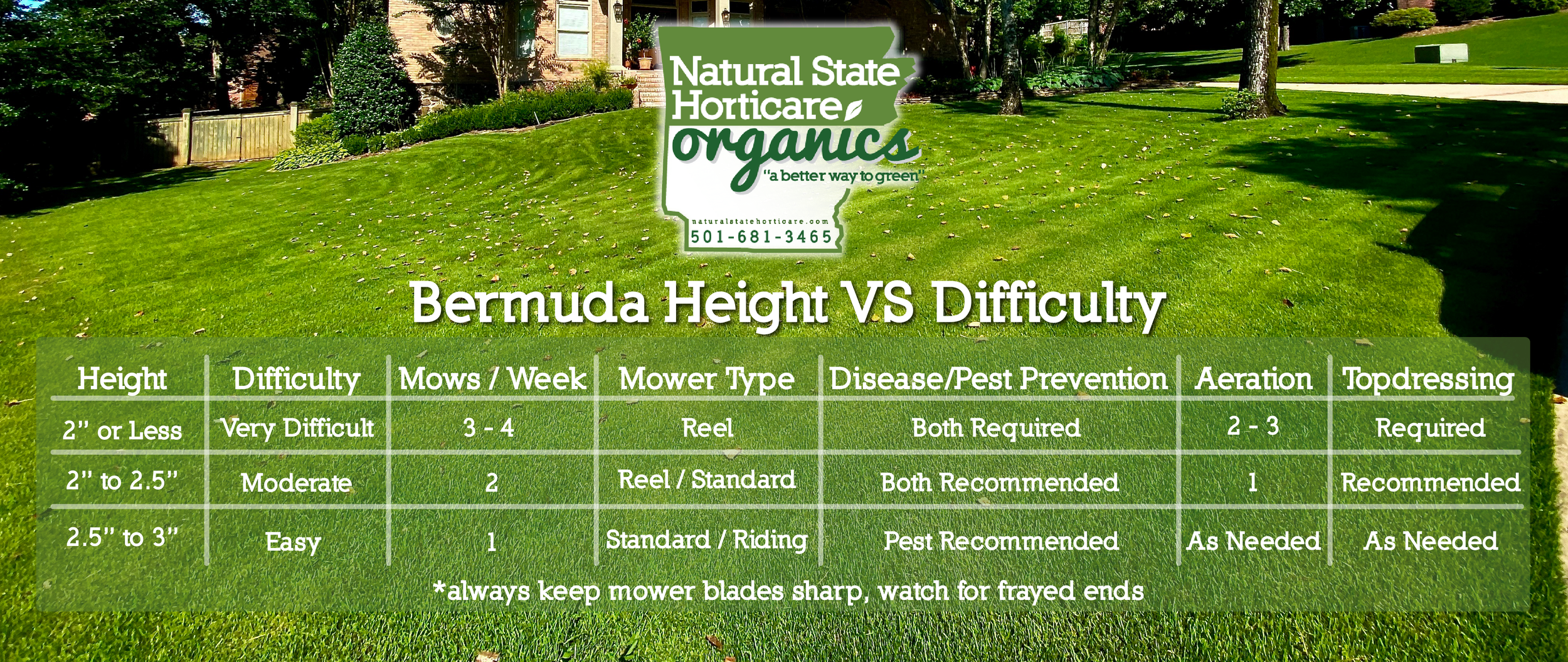
Bermudagrass grows quickly and requires frequent mowing to maintain a healthy, even appearance.
Remember, hybrid bermudagrasses (all Bermudagrass sod is hybrid) were developed specifically for golf courses and playing fields where mowing is done every 2-3 days.
-
2 .5 inches or lower for peak growing season.
Bermudagrass performs very well at heights below 2.5 inches. However, for every 0.5 inches below 2.5, your grass becomes more demanding. See chart
Bermudagrass kept too tall will remain thin and stringy no matter how much fertilizer you use. Mowing too tall and infrequent is the #1 mistake people make with this grass type.
-
Once per week during the growing season (May - September)
The more frequent the better. Seriously, go nuts!
Avoid cutting off more than ⅓ of the blade at a time except during your spring scalping.
-
Keep mower blades sharp to avoid damaging the grass blades.
Sharpen your blades every 15 mows. We recommend starting every season with two sets of sharp blades so they can be quickly and easily swapped during mowing season.
Try not to mow wet grass. It will have a tendency to tear instead of cut and can also cause clumping/clogging.
Change directions every time you mow. We recommend “Around the Clock Mowing.” Start by going 12 - 6. The next time you mow, go 2 - 8, then 3 - 9, 4 - 10, etc.
Don’t use heavy riding equipment in small or confined areas.
If you miss a mow or the grass has grown particularly tall, or it is time to do your Spring Scalp, we recommend bagging your clippings.
💡 Tip: Use a reel mower rather than a rotary mower for the cleanest cut, especially when attempting to maintain turf lower than 2 inches.
Watering Advice
Bermudagrass has excellent drought tolerance due to its deep root system, but it still needs regular watering to stay green and healthy.
For peak summer watering, these general recommendations work well for most lawns.
However, sun and soil conditions vary and must be accounted for when watering. For example, thin topsoil in full sun will need more water more frequently than rich, 6-inch-deep organic soil.
-
Zones with heads that rotate, oscillate, and most aboveground hose-end sprinklers should run for approximately 30 min per zone (or area before being moved).
Zones with stationary heads that spray mist should run approximately 12 minutes.
-
During most of the season, your bermudagrass will need water 3 days per week.
When drought is in effect, you will need to increase your watering frequency to 4 days per week (maybe more depending on soil quality).
-
Ideally, irrigation cycles should be run in the early morning. Generally speaking, 5 am is considered a good time to water.
Avoid watering in the late afternoon to avoid diseases caused by grass blades staying wet for too long.
However, water at the wrong time is far better than no water.
Regular watering before May will lead to disease
Before May, irrigation should only be run for “watering-in” treatments when recommended.
DO NOT stop watering too early. Reduce irrigation frequency and duration as dormancy approaches, but keep a close eye on signs of drought.
Drought-stressed grass can not accumulate carbohydrates and sugars in preparation for harsh winter conditions when drought-stressed.
Irrigaiton cycles should flutuate in volume and frequency in accordance with the weather.
-
Wilting, folded, or thin grass blades
Blue-gray hue or desaturated color
At this stage, grass will quickly rebound with a little extra water.
These blue-gray areas quickly turn brown and patchy
At this stage, recovery can take weeks. Once foliage is brown, it is dead.
Severe drought stress will cause the roots, rhizomes, and stolons to die back, exposing areas of dry topsoil.
At this stage, recovery can take months and may require labor-intensive interventions, if not new sod.
Bermudagrass NEEDS SUN!!!
Bermudagrass thrives in full sun and struggles in shade. Click here to learn more about shade issues.
6-8 hours of DIRECT sunlight per day.
Dappled sunlight through trees does NOT count as direct sun.
Dappled sunlight is better than fully blocked sunlight from houses, fences, and other solid structures.
Anything less than 6 hours of direct sun will begin to thin and generally underperform.
Disease & Pest Control
Bermudagrass is tough, but it's still vulnerable to certain pests and diseases, especially during hot, humid weather. Click here to learn more about common lawn pests.
Common Pests:
Armyworms – Sudden thinning and browning of grass
Grubs – Root damage, causing wilting and spongy turf
Common Diseases:
Dollar Spot – Small, round brown spots
Spring Dead Spot – Patches of dead grass that don’t recover in spring
💡 Tip: Proper mowing and watering reduce pest and disease risk. Treat infestations quickly with targeted insecticides or fungicides.
Winter Dormancy and Cold Tolerance
Bermudagrass will go dormant and turn brown when temperatures drop below 50°F. Bermudagrass is typically dormant by November, but warming weather patterns mean lawns are going dormant later.
Winter Care:
Once dormancy sets in, do one final mow to remove SOME material, clean up the last few leaves, and reduce the chance of matting.
This last mow should typically be lower than your peak season mow height, but should NOT be as low as your spring scalp.
Remove leaves and debris as they accumulate. DO NOT wait for the end of leaf season.
Avoid or at least minimize foot traffic on dormant grass to prevent damage.
Dormant grass isn’t growing and can’t recover when damaged.