
Masters of NONE
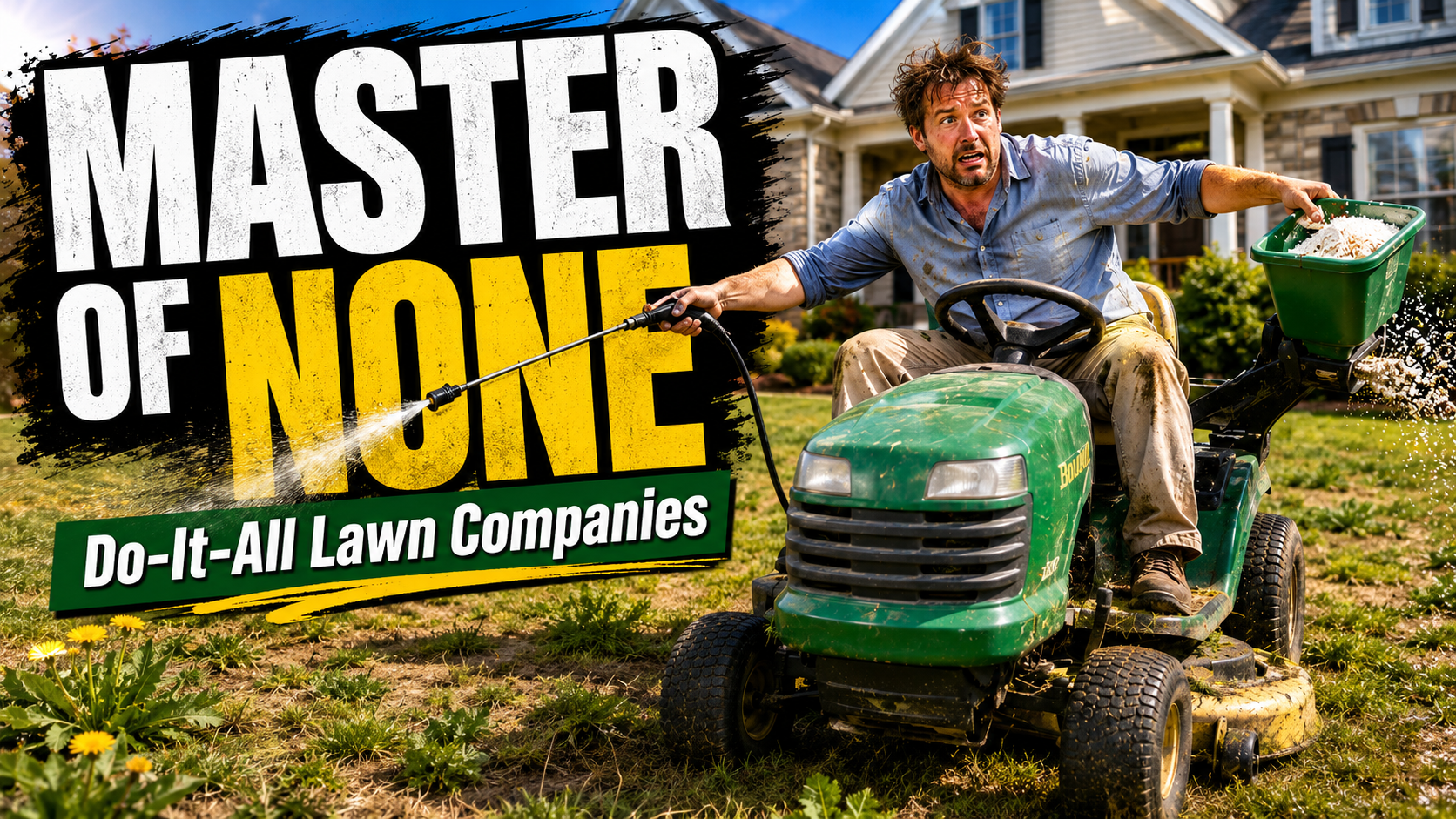
Why “Do-It-All” Lawn Companies Often Become Masters of None
There is a common misconception among homeowners that mowing, landscape maintenance, fertilization, and weed control are essentially the same.
They are not.
They all happen outside. They all involve grass. They all fall under the broad category of “lawn care.” But from a business, training, logistics, and expertise standpoint, they are completely different disciplines.
After more than 13 years of owning a fertilization- and weed-control-focused company, I can say this honestly: I have never personally known a “do-it-all” lawn service company that was truly excellent at every service it offered.
That does not mean those companies are lazy. It does not mean they do not care. It does not mean they are bad people or bad businesses.
It means specialization matters.
The Healthcare Analogy
Think about healthcare.
A heart surgeon is an expert in heart anatomy, physiology, and surgical intervention. If you need heart surgery, that person is indispensable.
But you would not expect your heart surgeon to also be your personal trainer, dietitian, primary care doctor, physical therapist, and pharmacist.
They are all connected to health, but they are not the same profession.
The same is true in lawn care.
Mowing is important. Maintenance is important. Irrigation is important. Fertility and weed control are important.
But each one requires a different kind of expertise.
A company can offer all of them. The question is whether they can truly master all of them.
In our experience, that is rare.
“Convenience” Comes at a Cost
The appeal of a do-it-all company is easy to understand.
One company. One phone number. One invoice. One person to call when something looks wrong.
That sounds convenient.
But convenience is not the same as expertise.
When a company tries to be everything, it has to divide its attention, training, equipment, leadership, hiring, and quality control across very different types of work. The result is often a business that is decent at several things but truly excellent at none.
Treatment work especially suffers when it becomes just another add-on.
Fertilization and weed control are not side services to be squeezed in between mowing routes. Done well, they require their own training systems, product philosophy, scheduling windows, equipment, documentation, and diagnostic process.
And the person making those decisions needs to understand more than how to operate a spreader or pull a spray hose.
Why We Chose to Specialize
Natural State Horticare did not start as a treatment-only company.
Like many companies, we began with mowing. We understand the work. We respect the work. We know how hard it is to do well.
But over time, we realized our greatest value was not in trying to do everything. It was in going deeper into the work that we were most passionate about.
There are plenty of mowing crews to choose from, but ZERO companies combining tried-and-true organic soil-building techniques with cutting-edge PGA golf-course-level products and techniques.
It is unfortunate, but NO other companies seem to care about reducing chemical exposure or building healthy soil. Repeated applications of generic nitrogen, blanket herbicide sprays, and minimal customer service are par for the course.
We thought Arkansas needed a more premium option.
The Bottom Line
A healthy lawn is not built by simply doing more things.
It is built by doing the right things, at the right time, for the right reason.
That requires expertise, discipline, and focus.
Do-it-all companies may sound convenient, but in lawn care, convenience can easily come at the expense of quality. When a company tries to master mowing, maintenance, treatments, irrigation, landscaping, drainage, hardscapes, and everything in between, something usually gives.
In our opinion, your lawn deserves more than a generalist.
It deserves a specialist.
At Natural State Horticare, we are not trying to be everything to everyone. We are focused on what we do best: building healthier lawns and landscapes through better agronomy, better products, better training, and fewer unnecessary chemicals.
That is our lane.
And we are very serious about staying in it.