
They Forgot the Soil
Ask any farmer, golf course superintendent, or agronomist, and they will tell you soil is THE most important piece of the puzzle in trying to grow healthy plants. If you get soil wrong, at best you get diminishing returns, and at worst you eventually lose the crops.
Considering that simple truth, we find it strange that most of our competitors are almost exclusively focused on applying nitrogen, maybe a small amount of phosphorus, potassium, and iron if you're on one of the better programs.

At Natural State Horticare, we take a different approach. We believe the healthiest lawns and landscapes are built from the soil up. That means fertility is not just about forcing quick color with nitrogen. It is about improving the soil environment so plants can grow stronger, recover faster, and naturally resist stress.
That is the foundation of our organic, soil-focused fertility philosophy.
Nitrogen Is Great But…
Nitrogen, applied as urea, is by far the most commonly used fertility product in all forms of agriculture. Its importance can not be ignored.
However, relying solely on urea for your lawn's fertility can have significant consequences.
Urea, like all nutrients, undergoes mineralization in the soil, where it is broken down by microorganisms and converted into plant-available forms, such as ammonium nitrogen and nitrate nitrogen.
This is why healthy soil biology matters. The more active the microbial community, the more efficiently the fertilizer is converted into usable nutrients. In simple terms, the fertilizer may supply the nitrogen, but the soil biology helps unlock it for the plant.
The Consequences of Being a “One Trick Pony”
If you rely solely on urea fertilizer and never replenish the soil, you can keep forcing short-term green growth while slowly weakening the soil system underneath the plant.
Urea supplies nitrogen, but it does not add meaningful organic matter, carbon, micronutrients, or biological diversity.
Here’s what can happen:
Soil organic matter declines.
Without compost, humates, root cycling, or other organic inputs, the soil loses structure and biological energy.Microbial activity becomes less balanced.
Nitrogen stimulates certain microbial processes, but without organic matter, the soil food web becomes less diverse and less resilient.Soil can become more acidic.
As urea converts into ammonium and then nitrate, hydrogen ions are released during nitrification. Over time, this can lower soil pH, especially in already acidic soils like we often see in Central Arkansas.Nutrients become less available.
As pH drops and organic matter declines, important nutrients like phosphorus, potassium, calcium, magnesium, iron, manganese, zinc, and copper can become deficient, imbalanced, or chemically “tied up.”Root systems may suffer.
Repeated nitrogen-only fertility can push top growth without equally supporting roots. The plant may look green for a while, but it becomes less drought-tolerant, less stress-tolerant, and more dependent on frequent feeding.The lawn or landscape becomes more chemically dependent.
Weak soil and stressed plants are more prone to weeds, disease, insect pressure, and poor recovery. That often leads to more herbicides, fungicides, and insecticides just to keep things looking acceptable.
In simple terms, urea can feed the plant, but it does not rebuild the soil. Used correctly, it can be a valuable tool. Used on its own year after year, it can create a greener but weaker system that requires more correction over time.
Healthy Soil Makes Fertilizer Work Better
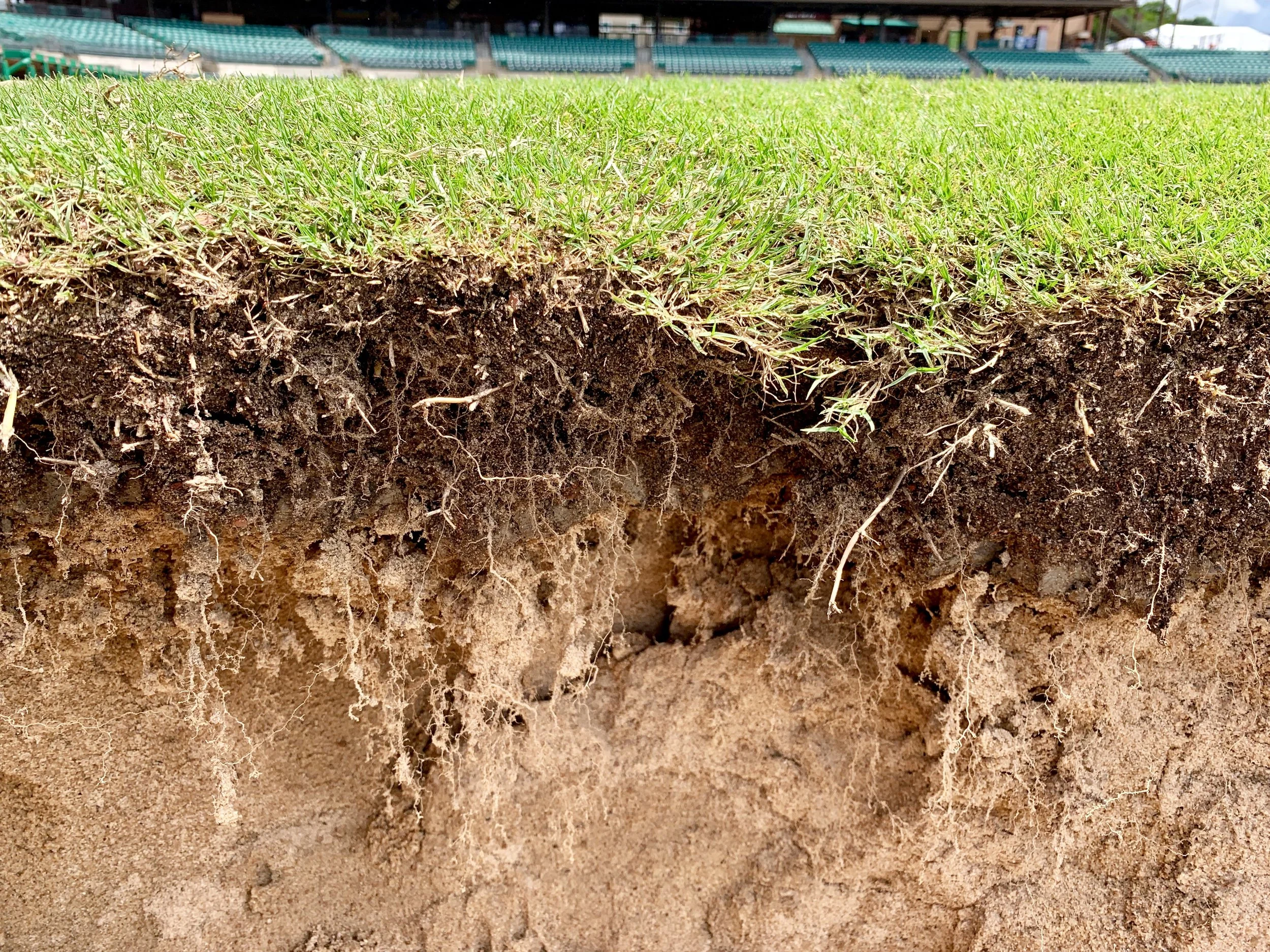
Soil is not just dirt. It is the living foundation of the entire landscape.
Healthy soil holds moisture more efficiently, stores nutrients more effectively, supports beneficial microorganisms, and allows roots to expand deeper and stronger. When soil is compacted, depleted, acidic, or biologically weak, the plant has to work harder for everything.
That is why we use organic inputs such as humic acids, kelp, fish-based products, compost extracts, and other carbon-rich materials as part of our fertility programs.
These ingredients do not just “green things up.” They help improve the soil environment so nutrients can be used more efficiently.
Organics Help Plants Defend Themselves Naturally
A weak plant invites problems.
When turf or ornamental plants are stressed, they become more vulnerable to insects, disease, drought damage, heat stress, and poor recovery. That does not mean every issue can be solved with fertility alone, but healthier plants are naturally better equipped to tolerate pressure.
Organic soil-focused fertility helps support that natural defense system.
Instead of constantly reacting to symptoms with chemicals, we focus on improving the plant’s baseline health. A stronger root system, better nutrient balance, and healthier soil biology all help the plant handle stress before it becomes a major problem.
That is the difference between a reactive program and a proactive one.
A reactive program waits for weeds, disease, and pests to become obvious.
A soil-first program builds stronger plants, so fewer problems reach that point.
The Long-Term Difference
Traditional fertility can create quick color.
Soil-focused fertility creates healthier plants.
There is a big difference.
Quick color may look good for a few weeks, but long-term plant health requires more than a flush of nitrogen. It requires roots. Soil biology. Nutrient balance. Moisture efficiency. pH management. Organic matter. Seasonal timing. Professional observation.
When all of those pieces work together, the landscape becomes stronger year after year.
That is why our program is built around more than just feeding the plant. We are improving the environment in which the plant lives.
A Better Way to Grow
At Natural State Horticare, our goal is not to force short-term results at the expense of long-term health.
Our goal is to build lawns and landscapes that are greener, stronger, safer, and more resilient over time.
Organic soil-focused fertility is one of the most important tools we have to make that happen. It helps us reduce unnecessary chemical use, improve plant health naturally, and deliver the premium results our clients expect.
Because the healthiest plants do not start with a bottle of fertilizer.
They start with healthy soil.